

Author’s Note: On November 1, I’ll be running the 2026 New York City Marathon in memory of my uncle Chris and in support of the Parkinson’s Foundation. As this newsletter lands in your inbox, I’m likely out on a hot, humid training run. If you’d like to learn more about Parkinson’s disease or support my fundraising efforts, you can visit my fundraising page here.
I’m sure you’ve heard of Reebok or Nautica before. But have you heard of Authentic Brands Group?
As a former brand operator, I was quite familiar with Authentic Brands Group (ABG) as the poster child for what a successful brand portfolio company at scale looks like. Oversimplifying, they buy brands with strong name recognition, and plug them onto their platform of brand management, marketing, and distribution. But here’s the catch, they often only acquire the intellectual property (IP) of the brand and then license it to operating partners. Their secret sauce is how they manage and build brands, while they outsource operations like logistics and fulfillment to third parties.
ABG is a brand portfolio in the most literal way. They literally buy the intangible asset that is the brand.
On the other end of the spectrum, you may have heard the company name, Bending Spoons, in the news lately. They’ve garnered plenty of buzz for their AOL acquisition (yes, the domain of your original email) which closed in January, and last week announced their acquisition of Airtable. Once you get past its ridiculous name, it’s a fascinating business model. The Italian software portfolio company buys strong brand recognition companies that have been on the decline or underperforming versus investor expectations. Their thesis is centered around buying “iconic products” and improving their operations.
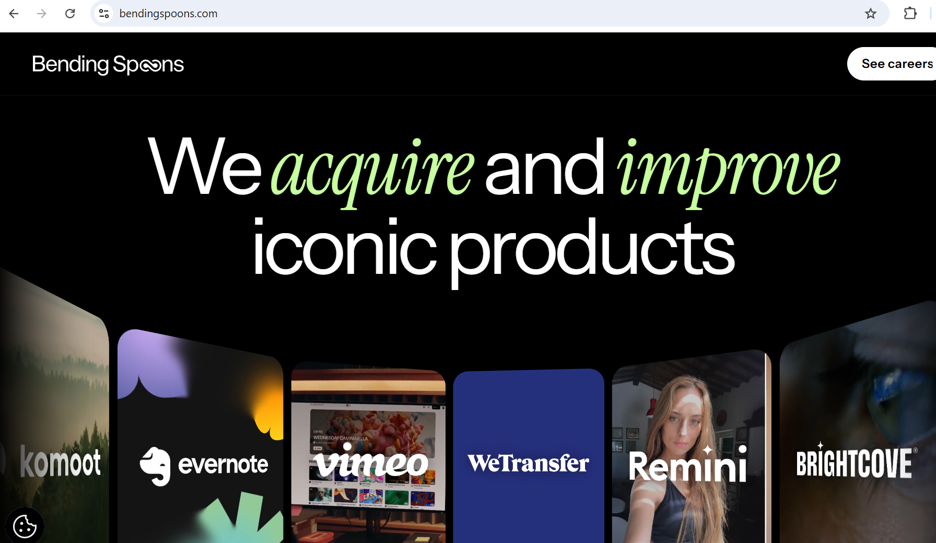
At a high level, Bending Spoons reminds me of the Authentic Brands Group of the software industry. ABG and Bending Spoons are two different manifestations of the same broader idea: buying assets whose existing customer recognition survives the deterioration of the original business.
Similar type of companies, just in different industries. Both recognize that customer recognition can remain valuable even after the underlying business begins to bleed. And it worked out well for them. ABG is valued at $20 billion as its last funding round in 2023 (with plans eventually IPO) and Bending Spoons trades at a market capitalization of $28 billion (as of August 7th, as per Yahoo Finance).
Tremendously valuable companies whose business model is giving brands a second chance.
This got me thinking. There will be an iteration of ABG and Bending Spoons for the AI era.
We’re currently living through a period of hyper-growth in technological capabilities. Hundreds of billions of dollars are being poured into AI infrastructure and model development, with trillions potentially following over the coming years.
It’s a race to acquire market share (or, if you want to be more evangelical about it, a race to artificial general intelligence).
Not every AI model or company is going to survive. At some point, I expect the flow of venture capital and Big Tech funds will slow down, and companies will need to inch towards self-sustainment through healthy unit economics and positive cash flow. Especially if they can’t reach public markets before the bubble pops. And if you’ve kept up with the news over the past few years, you are well informed that profitability has been low on the priority list for AI companies (for good reason though).
AI companies have an unusual problem because the technology underlying their product is increasingly becoming a commodity. A company can have a revered product today and discover that the underlying model economics have changed tomorrow. If your vertical AI company’s AI bill 10’xd overnight because the economics of the underlying models changed and subsequently, your unit economics are busted, what is left to your business? That becomes an easier question to answer if you’ve invested in your brand along the way.
Plenty of AI models and vertical AI startups will fail and need to be rescued by a company with larger market share or a private equity firm thinking they can squeeze out the bloat from the financials. But the AI companies that not only have a strong product but also have a respected brand will have an asset that becomes increasingly valuable as the technology underneath them commoditizes.
Think about the difference in branding between Anthropic and OpenAI. What do you think and feel when you read those two names? There’s no right or wrong answer. My point is that people have an emotional reaction to these names beyond their model capabilities.
Now let’s go to specific sectors. In legal tech, there’s Harvey and Legora. In finance, there’s Hebbia and Rogo. If you work in law or finance, what’s your take on the brands I mentioned? Do they have a brand worth remembering within your industry? If I haven’t mentioned AI startups in your line of work, think about the brands of the up-and-coming companies in lieu of the above examples.
Over time, the workflow may change. The same goes for the underlying model and model provider. However, the brand can remain. Eventually competition will win out and there will be industry consolidation, as well as AI companies that go bankrupt. And some will be scooped up by the next ABG or Bending Spoons.
I believe an AI company’s brand ethos should center around being your smart but humble friend. Someone who is trustworthy, diligent, and will admit when they are wrong.
Today, AI prompt responses can be overconfident, and people are still a bit unsure when to trust AI and when not to. This will be a constant struggle as models continue to develop and may never be fully solved. If you’ve watched the news, you’ve likely seen public backlash on the impact AI will have on the job market, environmental concerns, and whether the leaders of the frontier labs should have so much power.
A brand around transparency, wisdom, honesty, and curiosity will be an enduring asset if the operating model falters. Brand can preserve enterprise value even when the original technology or business model fails.
Back to brand holding companies. Not born yet, I believe there will be an AI version of ABG and Bending Spoons. A highly skilled operating holding company that acquires AI companies that couldn’t build an enduring business (perhaps unit economics were busted when the economics of the underlying frontier models changed) but did create an enduring brand that generated customer trust and retention. If the brand ethos powered customer trust, distribution, and organic user acquisition, a fallen company can be an attractive asset to this kind of portfolio.
Those AI companies will be given second acts. Their brand will live on.
Side note: if this idea of acquiring distressed AI businesses sounds interesting to you, please reach out in a few years. Particularly if you can bring a large credit facility to the table.
Time to wrap this up. The AI companies that survive the next five years won’t necessarily be the companies with the highest-performing models, the most robust features, or even the largest user base today. And I suspect many of the survivors will be the companies that have invested in their brand.
And if the history of companies like Authentic Brands Group and Bending Spoons tells us anything, there may eventually be an entire industry built around buying the brands of yesterday and giving them the technology of tomorrow.