

Author’s Note: On November 1, I’ll be running the 2026 New York City Marathon in memory of my uncle Chris and in support of the Parkinson’s Foundation. As this newsletter lands in your inbox, I’m likely out on a hot, humid training run. If you’d like to learn more about Parkinson’s disease or support my fundraising efforts, you can visit my fundraising page here.
As you can imagine, I’m fascinated by how quickly technology develops and the impact AI has already had on how people work. But at the same time, AI has made some things quite weird.
There are AI companions like Character AI that people treat as their friend or romantic partner, with the average user spending over 1.5 hours per day on their app. You also have AI companies opening 24/7 cafés (Corgi Café), with branded drinks from other AI companies.
Oh, and then you have Google buying bankrupt airline Spirit’s data to improve their models.
The sale is still under review, but it looks like Spirit will live on in a different form. You won’t be booking a 5 AM flight to Vegas with the most eclectic people you could possibly assemble anymore on a yellow hunk of metal, but Spirit’s knowledge base may provide an assist in a Gemini prompt response.
Here’s what happened: Google won a bidding war against enterprise data broker Mercor and ultimately paid $10 million for a head-scratching amount of data. Check out the below snapshot of what Google is looking to scoop up from Spirit.
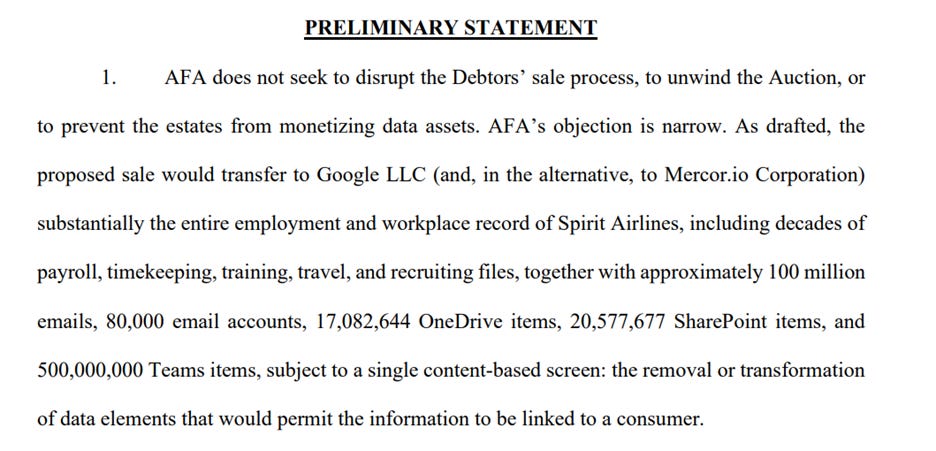
That’s a lot of data, to say the least. And it’s worth mentioning that Google will be scrubbing any personally identifiable information (PII) from this data, a key point of the agreed-upon sale.
Here’s the quote from the article linked above that confirms Google’s thirst for data:
“We acquired part of an enterprise dataset from Spirit Airlines, which can be helpful in improving our products and AI models,” the spokesperson said. “We will not receive any personal information from this dataset. Any data we receive will be rigorously scrubbed of any personally identifiable information by a third party before receipt.”
So why would anyone pay $10 million for the carcass of a bankrupt company? Because although the company may be dead, its accumulated knowledge sure isn’t.
Let’s unpack a few things here.
Switching gears: as AI model companies look to acquire new sources of data to train their models, they’ll need to be more creative as the obvious locations start to dwindle. Once the open web has been scraped, you must look in every cranny. We’ve chatted about the physical AI narrative in the past and how companies like DoorDash are paying Taskers to record themselves delivering food and selling the recordings as data to help build autonomous devices like delivery robots.
But showing up at a fallen company’s liquidation proceedings is a new one (or at least from my surveillance of the topic). Distressed firms that may have been disproportionately impacted by an adverse macro trend or may have made a few bad decisions and find themselves past the point of no return. Thus, they need to lick their wounds and sell the business off for parts.
AI is making corporate data a liquidation asset. What Google’s bidding war for Spirit’s operational data shows is that the “parts” just got more valuable. If you’re a creditor to a bankrupt company, there’s a chance you could recover a bit more money than expected if the data can be valuable for model training.
There may be a new cast of characters showing up at a liquidation proceeding, looking to get their hands on a fallen angel’s data. I expect we’ll see more legal documents including names like Google, OpenAI, Anthropic, and SpaceXAI putting forth generous bids. The hope would be to pick up niche data that may be able to fit a specific use case or provide more data in general.
But in my opinion, I don’t think this is a big deal from a creditor perspective. Whether you own the bonds of a distressed company or are an opportunistic investor analyzing the credit default swaps on these bonds, it’s unlikely that the amount paid on the data set by AI model firms is likely going to move the needle. In the context of Spirit, an extra $10 million is appreciated, but when there’s billions of dollars of debt, it may as well be loose change. I see this as a “one man’s trash is another man’s treasure” situation.
I have to think that the corporate development teams at Big Tech are going to be busier after this precedent, scouring the earth for soon-to-be bankrupt companies that need to sell off their data as part of liquidation. The opportunity to pick up niche, real-world enterprise data generated through decades of actually operating a business doesn’t come up every day.
Google wades into a gray area from an ethical and compliance perspective when it comes to acquiring employee data. Among those hundred million emails are people’s names and the things they’ve written. All of this was originally under the assumption that their messages wouldn’t be bought by Google.
So, Google will rely on a third party to scrub Spirit’s data for anything that could be traced back to an individual person. It’s worth mentioning that Mercor’s bid stipulated that Mercor itself would scrub the data. No wonder they lost. Who would trust a company that sells data for AI models to not let profit control their decision-making here? But even with a third party filtering the data before the keys are handed to Google, there is still concern that Google will find a way to reverse-engineer who said what in these conversations for the sake of improving models. The worst-case scenario is that a Gemini prompt response mentions a specific Spirit employee’s name on a matter that they thought was a private business matter
At this point, most people have heard of ChatGPT or Gemini and have at least a basic understanding that you can ask a question and get a curated answer in return. There is considerable anxiety about what Google will do with this information, given some of the sensitivity around it. Worth noting that customer information is not included in what Google is buying, only employee data.
The obvious wrinkle is privacy. Google says the data will be de-identified by a third party before it receives it. The flight attendants’ union isn’t convinced that’s enough, arguing that links between datasets could still allow individuals to be identified. The court has delayed the hearing on the sale until September 9. So we’ll see what happens, but if I were a betting man, I’d imagine Google walks away with the prize.
Let’s wrap this up. A new line item on the liquidation checklist seems to have appeared, and that’s “what is the company’s data worth to an AI company?” The next time a company goes bankrupt, don’t just look at its planes, factories, patents, or customer list. Check out the data. There may be an AI company waiting to bid on it.