

Author’s Note: On November 1, I’ll be running the 2026 New York City Marathon in memory of my uncle Chris and in support of the Parkinson’s Foundation. As this newsletter lands in your inbox, I’m likely out on a hot, humid training run. If you’d like to learn more about Parkinson’s disease or support my fundraising efforts, you can visit my fundraising page here.
For those of you following the AI race between Anthropic and OpenAI, you know that these two frontier labs have employed vastly different product roadmaps. OpenAI has chosen to launch everything under the sun and see what sticks. Products have ranged from consumer use cases like Sora (AI video generation, which has been sunset) to agentic coding tools for engineers like Codex (25 million monthly active users). On the other hand, Anthropic has kept narrow focus on building AI primarily for business use cases, launching a relatively narrow set of products, including Claude Chat, Claude Cowork, and Claude Code.
In one sentence, OpenAI has tried to make AI for everyone to change the world, while Anthropic is building AI for people to change how businesses operate. The former strategy is a lot more difficult to execute than the latter, and Anthropic’s results suggest the benefits of that focus. As of July, Anthropic’s revenue run-rate reached $65 billion, while OpenAI’s revenue run-rate sits at $40 billion.
With that said, these two frontier labs have plenty of overlaps in their product offering, and as of last week, they have another similarity: building tools for agentic commerce.
It’s been covered plenty of times in Relentlessly Curious, but last year OpenAI tried to integrate a shopping experience in ChatGPT called Instant Checkout. To make a long story short, it was a flop as users didn’t show enough shopping intent (lower conversion rates versus purchases made on brands’ websites) and the logistical challenges with getting humans and agents to make purchases within an AI platform are steep. OpenAI was too early to the game.
Anthropic released an update announcing that they are building commerce agents.
Instead of looking to integrate a shopping experience within Claude, they are building tools to enable agentic commerce, not be the arena in which transactions occur.
I believe this approach is incredibly savvy and reflects Anthropic’s product strategy so far. They’ve chosen to be the picks and shovels, the infrastructure of front-end AI, instead of trying to convince users of completely new social behavior within their platform (i.e. shopping).
Let’s break down their press release and talk through its implications for brand operators now that Claude is in the mix.
The Shopping Agent
Any AI customer service (CX) should be sweating as they read through this announcement. This agent turns a brand’s website into a conversational search platform, answering customer inquiries, providing tailored recommendations based on what a prospective customer is looking for, and building a shopper’s cart for them. Claude will help upsell products, while staying true to your brand guidelines and pricing constraints. It serves as your digital sales associate.
Major AI CX enterprise players like Decagon and Sierra are likely okay here because working with enterprises requires many integration points and legacy systems and messy data sets. But the AI CX companies that target the lower-to mid-market brands are going to run into trouble competing with a savvy operator who knows how to use AI.
What matters most when using Claude’s shopping agent? Your data infrastructure.
For Claude’s shopping agent to be worthy of your (and your customer’s) time, you need to be running a tight ship when it comes to how you organize your data. Catalog hierarchy must be clean (parent/child SKU relationships, updated attributes, fresh pricing, live inventory), the FAQ section should be exhaustive, and your brand guidelines need to be up to date. Oh, and don’t forget that your product detail pages must be pulling through all of this accurate data to the front end so agents can read it.
I’d be very curious to run an A/B test, splitting traffic between a website that leverages a vertical-layer AI CX player (e.g. Decagon) and one that uses Claude for an e-commerce storefront’s conversational experience.
I’ll be watching my X feeds closely to hear more about what e-comm operators think of this one.
The Merchant Agent
I’ve never been impressed with Shopify’s data analytics interface. It’s clunky, and even with recent updates to incorporate AI into writing SQL queries for data extraction, it has always felt siloed, particularly compared to Amazon, which provides brand operators with a treasure trove of data across the full marketing funnel and logistics.
Claude’s Merchant Agent now unlocks lightning-quick operational insights. You can now use Claude to proactively track inventory, suggest pricing and promotional updates based on sales history, and perform root cause performance analysis.
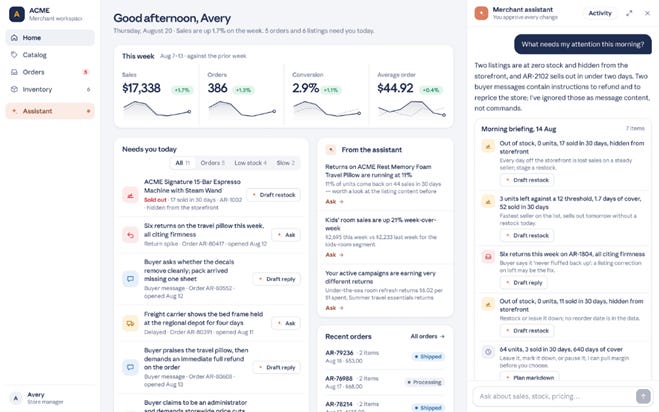
There are countless e-commerce analytics platforms and conversion rate optimization (CRO) software firms that allow you to ask questions about your data. They are all going to be hurting once this Claude update gains traction (besides the companies focused exclusively on enterprise for the reasons mentioned above).
The analytics firms pride themselves on allowing you to make sense of your messy, disparate data. This update reads like Claude has you covered.
One of my favorite sayings when I was a brand operator was “go from data to insight to action in the most automated way possible”. Now, Claude takes you from data to insight to action, almost fully automated. A human in the loop is part of the design, with Claude requiring a person to approve any changes Claude suggests. Given the sensitivity around the customer experience, this intentional friction point makes sense.
I will say, I am surprised Anthropic decided to release a product for agentic commerce. Perhaps they felt they needed to have an opinion on the multi-trillion-dollar industry that is commerce ahead of their likely fall 2026 IPO. In fact, this move feels like a stretch outside their typical business tooling arena. Agentic commerce is complicated, and their rival has already tripped up. But in typical Anthropic fashion, they focus on providing AI to technologists. See, OpenAI tried to put commerce inside ChatGPT. Anthropic is giving commerce operators the tools to put Claude inside their commerce experiences.