

A few weeks ago, Google released their latest series of foundational models, Gemini 3. Their update rocked the news cycles and the stock market, with technologists and journalists praising Gemini’s new reasoning, agentic coding, and multimodal capabilities. Since the announcement, Google’s stock is up 13% (as of 12/5) and OpenAI has publicly claimed they are on their heels as Google has taken the lead in the AI race.
It’s unlike Big Tech to publicly acknowledge how strong another’s models are. Which means that the Gemini 3 update is worth paying attention to.
Now Gemini 3 has several cutting-edge features, however in today’s edition, I’d like to draw attention to the one with the silliest name: Nano Banana Pro. Don’t let this cutesy name distract you. Many regard its image generation ability as the best on the market given how realistic its output is.
Personally, I’ve played around with Nano Banana Pro and Flux (another image generation model) and believe that Nano Banana Pro is far and away the best image generation when it comes to realism and fewer hallucinations. It’s also a big upgrade from the original, Nano Banana, which was trained on Gemini 2.5.
Head to Gemini to check out the new feature.
Let’s try out this first prompt:
“Selfie taken by Michael Jordan with LeBron James hanging out on the golf course at sunset”
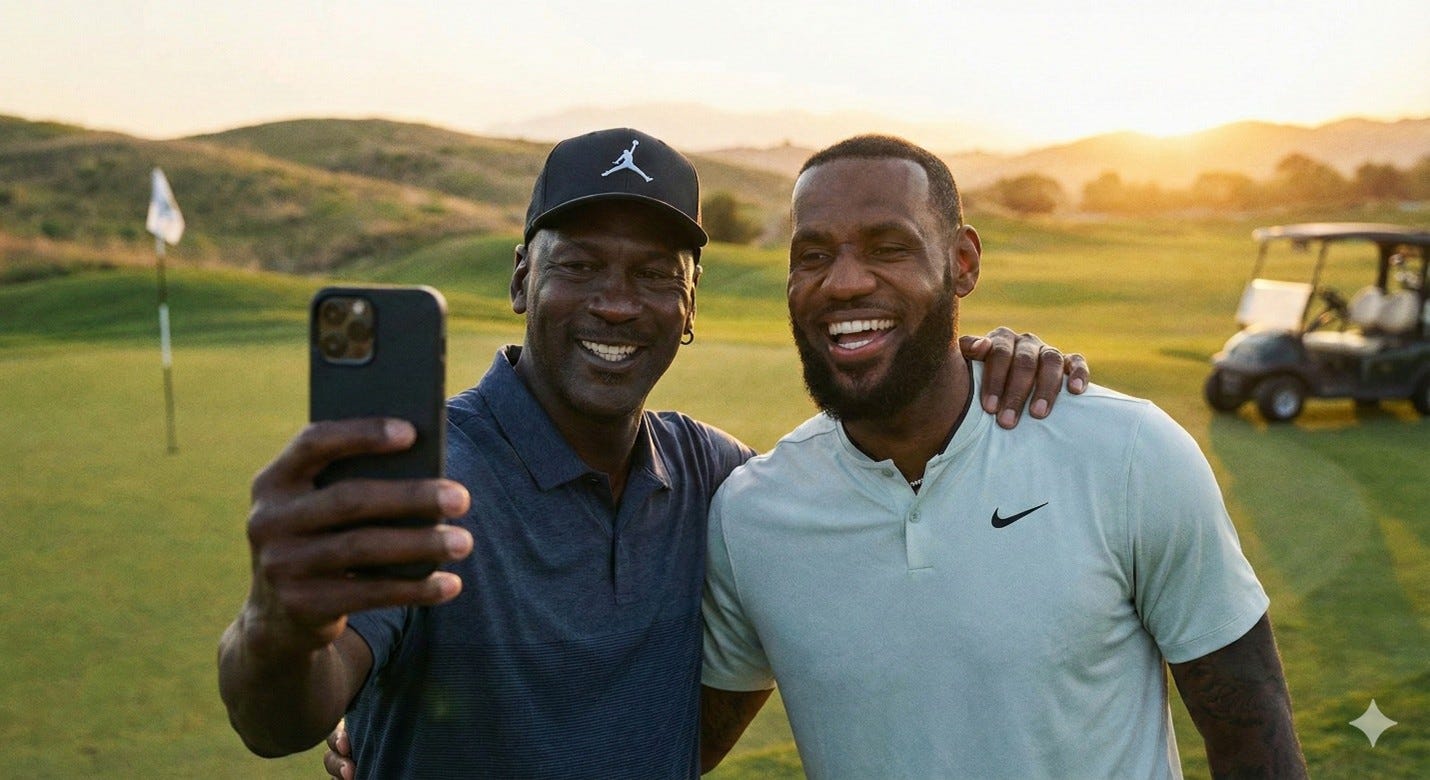
All five fingers seem to be present. Good sign. Let’s try another one.
“Create an image of sunrise in West Village, NYC (40.73 N, 74.00 W)”
(Yes, I’m giving it coordinates to finetune the location)

Realistic street corner at sunrise. But as a former resident, I don’t recall that awning. Still, impressive image.
Like Whey protein?* So does Jalen Brunson.
“Jalen Brunson holding an Optimum Whey Protein container during a Knicks pregame warm-up”

*For Jalen’s sake, Google includes a Gemini Watermark at the bottom right of images to depict that it’s AI-generated. However, this watermark can be removed with 3rd-party tools. What can’t be removed is an invisible watermark that Google places on each photo, keeping the AI fingerprints on their creation.
These images were created from simple prompts. Pro tip: provide camera lens settings and you can really customize your image to your vision.
I’m sure your mind is racing thinking about the impacts Nano Banana Pro can have on every industry. Let’s dive into a few examples.
E-Commerce
As someone who works in e-commerce, I’ve been searching for the past 18 months for a half-way decent image generation tool. To date, even the most impressive tools (Flux, Flair, Midjourney) have shown clear faults. From an extra finger to bizarre facial features and misinterpreting my prompts, AI image tools always carried an asterisk with them.
I’ll tell you what: Nano Banana Pro is running around with a much smaller asterisk. It’s not perfect. Sometimes I’ll have trouble editing text from one image to another, as well as seeing aspects in output that didn’t align with my prompt. But when the photo comes out as I had hoped, I’m mesmerized that it wasn’t taken by a person. I feel like I’ve witnessed magic.
Nano Banana Pro disrupts both traditional photoshoots for website content and advertising. If you start with a high-quality rendering of your product, the world is your canvas in terms of the types of settings, backgrounds, and use case demonstrations you can create for your product.
This technology accelerates the amount of experiments a brand can conduct. Photoshoots are a costly bottleneck, straining financial budgets and slowing down pace. Now with Nano Banana Pro, brands can test many different iterations of copy and content for an ad on social media or the main image on their product page. This workflow allows teams to get to the best possible answer quicker.
Film
If you’re working on set in Hollywood, you must be sweating right now. That is, if you haven’t already been sweating as the streaming business model and now AI have turned the film industry on its head.
With Gemini’s Nano Banana Pro, it’s not difficult to imagine a world where fewer people are needed to make movies. Casts and crews will be a fraction of what they once were as AI will continue to pave the way, reducing the cost and increasing the pace of production.
What’s crazy to think about is that today is the worst image and video technology is. It will only continue to get better. The issues we see today will likely be fixed within a year, if not months. What I’m curious about is when we’ll be able to create TV sitcoms and movies from simply writing prompts. I don’t know if that’ll catch on, but
More content, more creation. But fewer jobs at film studios.
Architecture
Architecture is admittedly outside my comfort zone, but even from the sidelines it’s obvious how big this shift could be. Today, architects rely heavily on CAD tools and manual rendering work to translate sketches into something clients can visualize. With models like Nano Banana Pro, that translation layer becomes dramatically faster. A 2D floor plan or rough sketch could turn into a photorealistic, explorable 3D space in minutes instead of days.
That doesn’t replace architects, it just removes some of the most time-consuming production work. I expect new software players to emerge that focus on prompt design, workflows, and templates specifically for architecture firms, all built on top of Nano Banana Pro. As we’ve talked about in past editions, the biggest opportunities usually sit at the vertical application layer, and architecture is poised for that kind of tooling.
Education
If you’re a visual learner stuck with dense reading assignments, Nano Banana Pro changes the game. You can upload a confusing passage and instantly turn it into a diagram, timeline, or even a quick explainer video tailored to your learning style. It removes the “I don’t get this because of how it was taught” excuse.
Google’s Notebook LM adds another layer by acting as a research partner: it can turn notes into summaries, study guides, or a podcast-style explanation of a topic. Put together, these tools make it far easier for teachers to build custom learning materials and for students to grasp complex ideas quickly.
What this means for education is complicated. The accessibility boost is undeniable, but it also raises new questions around overreliance, academic integrity, and how educators adapt. Still, the direction is clear: learning will become more personalized, more multimodal, and less constrained by traditional formats.