

On Sunday, Shopify announced a major partnership with Google, unveiling the Unified Commerce Protocol (UCP). This jointly developed set of standards helps establish the tone for how agentic commerce will operate technically. The UCP lays the groundwork for checkout flows on agentic storefronts such as Google’s AI Mode and Gemini, as well as Microsoft’s Copilot.
What does this mean from a user perspective? Customers will be able to provide payment details, submit discount codes, and set up a subscription all within their prompt inquiry. So, the next time you ask Gemini to, “find and buy running shoes in size X that meet Y requirements”, you don’t have to leave Gemini to check out on the brand’s website. AI chatbots are becoming a true one-stop shop.
Need a refresher on agentic commerce? It’s when AI agents buy things on behalf of people. We give AI agents instructions on what we are looking to buy, along with conditions around price, features, and payment information. Then, an AI agent makes the purchase on a person’s behalf. These types of purchases can be triggered by a prompt we write to an AI chatbot like Google’s AI Mode, and they can also be triggered by a set of predefined guardrails (a workflow) that we’ll unpack in the morning wake-up scenario below.
“Your alarm clock goes off at 7AM. You immediately regret going to bed late last night and choose to hit the snooze button.
After nine minutes go by and another ring goes off, you check your phone to see a weak sleep score on your Whoop app.
Ping! You get a few more notifications on your phone coming from Instacart, Starbucks, and Peloton.
Instacart adjusts your grocery delivery order today adding more fruits and vegetables since your sleep score was low, and your Starbucks order changes your typical latte to a red eye since you are dragging. Then Peloton swaps your heavy-lifting session to cardio and stretching as your body’s strain level is too high for the former. You’ve provided pre-approval on spend limits, so the apps can work in sync with each other and execute transactions so that you can be optimized in the way that you prefer.”
Agentic commerce is nothing new here in Relentlessly Curious land. The excerpt above is from last May, when we chatted about a world where AI agents make decisions for us in When AI Buys Your Groceries.
The idea of AI agents acting on our behalf has been thrown around for a while. However, Shopify’s announcement (strategically timed on the first day of a massive retail conference, NRF 2026) is a key milestone in laying the foundation for the scenario imagined above.
What Shopify has been to websites, it is attempting to be to agentic commerce. For the past 20 or so years, people have visited websites to ultimately make a purchase of a good or service.
But expect to see a behavioral shift in the short term. How people discover information is already fundamentally changing (think less reliance on Google Search and more reliance on AI chatbots), and shopping is the next big habit to change.
The Shopify and Google partnership represents the ability for any brand (whether they are using Shopify to power their website or not) to have a shoppable catalog for AI agents. It creates the protocol for how a brand’s catalog is read and ingested by AI agents, so that the proper information is communicated to the person (or AI agent) prior to making the purchase.
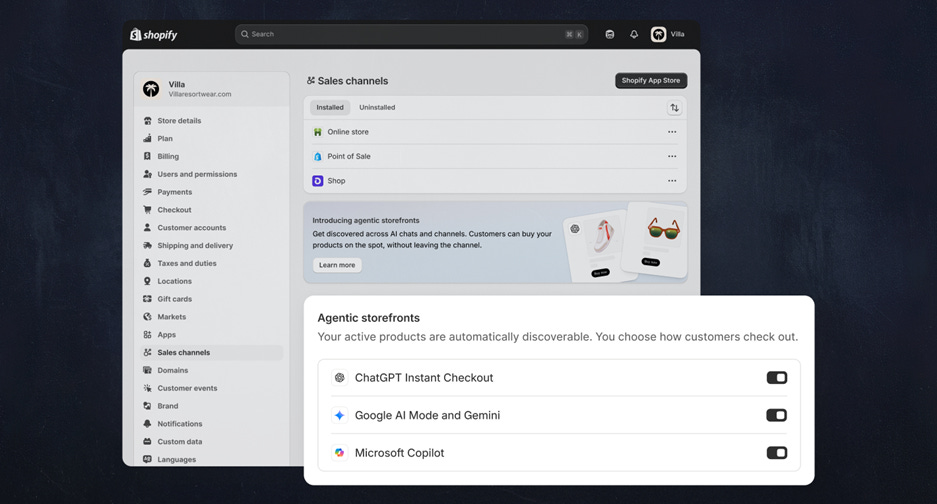
This screenshot is from the press release. The key callout is the list of names under “agentic storefronts.” None of these are “[insert brand].com”.
I believe Shopify is putting so much effort into establishing a protocol for how AI agents shop across the web because its business model faces an existential threat if people begin buying from AI chat interfaces (i.e., agentic storefronts), and they don’t have a piece of that business. Maybe not today, but perhaps three years from now. If people stop visiting websites, there’s less reason for a brand to put so much effort into maintaining their website and thus paying high subscription and transaction fees to Shopify. Shopify knows where the puck is going and is building the next generation commerce infrastructure to stay on top.
The difference is, shoppers will come in the form of both people and AI agents. And that’s what all the fuss is about regarding the UCP news. Agentic commerce requires a retooling of the existing front-end and back-end e-commerce experience to support both people and AI agents making purchases.
A few thoughts.
Understanding customer intent will be an incredibly tricky exercise.
You type in, “Buy me new running shoes at a price below $150.”
This is a vague prompt to tell an AI agent. There is a nearly infinite number of outcomes the AI agent can come up with to satisfy your running shoe request. Agentic commerce will need to have the proper guardrails for keeping a human in the loop to provide the necessary information prior to taking an action. In this instance, the size and width of the shoes, color, style, intended use (long-distance or track running), and climate should be filled out before the agent begins its research and makes a purchase.
And say a customer doesn’t like the shoes the AI agent purchases on their behalf. Do they take this up with the AI agent or do they email the brand asking to return the product? Customer service is another nuanced element of the commerce experience. I didn’t see any post-purchase information in Shopify’s announcement.
Building intent-based models to help refine the prompt inputs feeding agentic commerce will be key to limiting disruption of the buying process.
Brand becomes everything and nothing at the same time.
Websites can be an excellent educational hub for a brand. But if customers don’t make it to your website because they checked out within an agentic storefront, they are less likely to learn the brand story or understand the full assortment.
That poses a major problem for brand loyalty. Customers will put their trust into what ChatGPT recommends. That means that unless they intentionally seek your brand out, you’re at the whims of whatever ChatGPT recommends.
And I haven’t mentioned what happens when AI agents act on your behalf to make a purchase. If you don’t specify which brand you’d like to buy from, brand may as well be meaningless in the eyes of an agent.
I believe agentic commerce will force brands to be built offline, or they’ll have to become top notch pupils of the generative engine optimization game.
How your brand is perceived and how frequently it shows up in AI search results will be critical for agentic commerce success.
Practices like generative engine optimization (GEO) will become (if not already) a key strategy for brands looking to improve their visibility in AI search results. With Google Search’s growth rate slowing and AI platforms like ChatGPT seeing nearly 900 million weekly active users, AI search is an acquisition channel you can no longer ignore. Creating content that’s easily indexable and retrievable by LLMs (proper schema markup, FAQ pages, etc.) and maintaining a presence on relevant LLM data sources for your brand (i.e., Reddit, YouTube) will take up a larger mindshare for growth marketers. You’ll need to make sure you’re marketing to AI agents, which is a different strategy than marketing to people.
Agentic commerce disrupts the priority of owning the customer relationship.
In either OpenAI’s Agentic Commerce Protocol (ACP) or Shopify’s and Google’s Unified Commerce Protocol (UCP), the brand will maintain its status as the merchant of record. This means that they receive the opportunity to collect email or phone number information, as well as transaction data.
But sending a customer a slew of emails suddenly becomes less relevant when they are going to ChatGPT or Gemini for guidance on what to buy. Continuing this tangent even further: if a person delegates buying decisions to an AI agent, the emails that land in that person’s inbox are essentially irrelevant, even if they have been opened or not.
Savvy marketers will still find a way to generate value from an email list, and transaction data is critical to better understand the business. But email as sales and retention channels will likely become a lot less relevant.