

On Friday, OpenAI announced plans to introduce advertising within ChatGPT’s free and Go tiers over the coming weeks. This long-awaited press release has been a focal point of industry chatter, and I believe this is a logical next step in OpenAI’s dominance and disruption of entire industries.
We’ve discussed the concept of advertising within AI chatbots several times at Relentlessly Curious, most recently detailing why advertising was the next likely business opportunity for OpenAI in #62: OpenAI’s Monetization Roadmap. Given the sheer amount of capital that OpenAI has raised, it needs to pursue trillion-dollar industries. They are currently checking the “commerce” box with their Instant Checkout rollout and appear to have plans to enter another trillion-dollar industry: advertising.
But I have doubts about OpenAI’s ability to create a successful advertising product in the near term, being roughly the next twelve months. By contrast, Amazon is much better positioned to create the ad product that OpenAI aspires to achieve.
In theory, advertising within AI chatbots should be an effective acquisition channel. Foundational models like OpenAI have plenty of historical context on your lifestyle habits and specific preferences, and they can use this data to target you at the right moment with the right product. The goal is the right place, right product, right time. You type in a prompt and ChatGPT provides an answer, with a small “sponsored” section at the bottom.
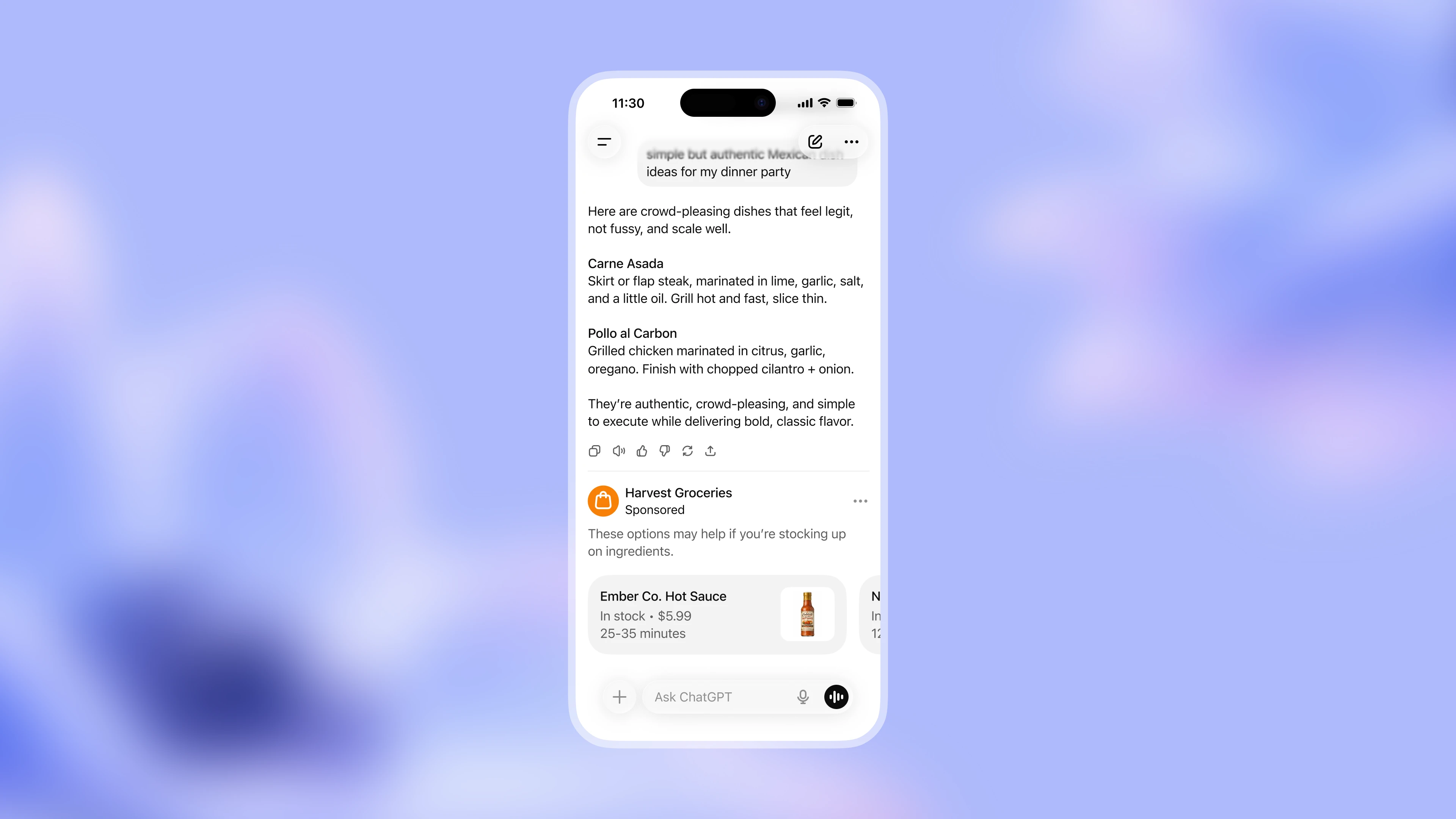
Thanks to ChatGPT’s nearly 900 million weekly active users, OpenAI has no shortage of data points to provide a user with hyper-specific advertisements. More precisely curated ads should translate into higher conversion rates on these ads. The combination of hyper-specific audience targeting and high conversion rates is a unicorn scenario.
As a result, OpenAI should expect to command a high price for this precious advertising placement due to the intersection of a curated audience and a contextually relevant moment. A common benchmark for advertising prices, cost per mille (CPM), islikely to be priced quite high because of these dynamics. An AI chatbot is direct response advertising at its most powerful. It’s as good as a marketer can dream up.
However, this optimistic scenario makes a few key assumptions.
First, it assumes the ChatGPT user is looking to make a purchase. There are plenty of reasons why someone may use ChatGPT beyond looking for guidance on buying something. In September, OpenAI published the “How people are using ChatGPT” report which claims that the ‘Doing’ category of tasks, which represents roughly 40% of consumer usage, encompasses task-oriented interactions like drafting text, planning, or programming.
That’s 40% of inquiries that don’t have to do with shopping. My guess is that when someone visits Amazon’s website, they generally intend to buy something. That is not always the case with ChatGPT.
Moreover, OpenAI claims it will allow users to clear any data used to inform ads at any time, as well as “never sell… data to advertisers.” OpenAI has a treasure chest of relevant data, but it’s up in the air about how much of it they’ll be able to use to show you an ad. This is reassuring from a consumer perspective. At the same time, it raises questions about how relevant the ads can be if OpenAI cannot act on all user data.
Additionally, creating a great advertising product is difficult and challenges the ethos of its core software. OpenAI knows this, and its deliberation suggests both caution and a need for experimentation. Friday’s press release reads almost like an open admission of difficulty and that they won’t ruin their core product with advertising.
Platforms walk a fine line between preserving their mission and serving advertisers. But there is one platform that is pushing full steam ahead in implementing advertising within their AI chatbot. That platform is Amazon.
Amazon’s AI shopping assistant, Rufus, can serve as a benchmark for ChatGPT advertising.
According to Amazon’s Q3 earnings report, Amazon claims that shoppers who engage with Rufus demonstrate a 60% higher conversion rate than shoppers who do not engage with Rufus, as well as generating an incremental $10B in revenue. In addition, roughly 250 million people use Rufus each month. How’s that for adoption?
Rufus seems to be a success so far. But how effective is advertising within Rufus’ interface?
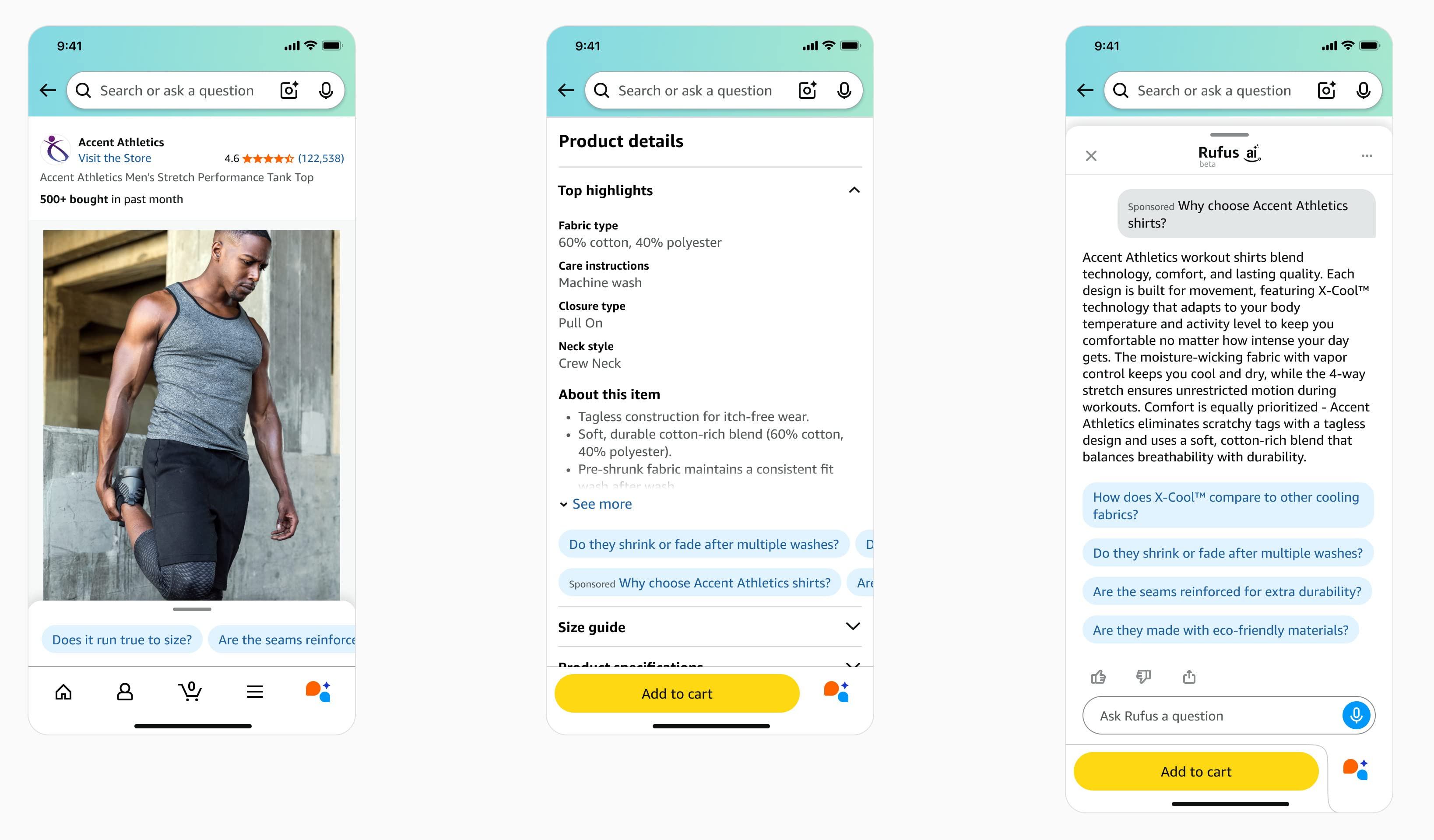
As of now, Amazon does not give brands the option to bid on ad placements within Rufus. Instead, Amazon will sometimes slot a brand’s Sponsored Products and Sponsored Brands advertising into Rufus as a test. Consequentally, this means this means that brands do not have a direct way of assessing ad performance within AI chatbots.
But I’ll attempt to make this corollary: if brands were seeing high returns from Rufus advertising placements, Amazon would separate out Rufus into its own campaign structure and charge brands high rates for the placement. But that’s not happening.
Amazon’s cost-per-click (CPC) costs have not increased astronomically over the last year, despite their Rufus testing. In the Beauty category, Sponsored Products (think ads on a search results page) CPCs averaged between $1.04 and $1.12 in 2025, which is up 10 to 15% when compared to 2024. This is a meaningful increase, but not dramatic, and can be the result of many factors.
Rufus leverages Amazon Bedrock, an internally developed LLM that incorporates billions of product data points, decades of sales history, and many millions of customer reviews. They are much better positioned to build a high-converting advertising product than OpenAI since they have an endless supply of commerce-oriented data.
Rufus may be effective at organic recommendations (as per the financial statistics that Amazon shared), but perhaps the advertising placement within the chatbot is not quite right. Whether customers are less interested in engaging with ads inside a chatbot (existential issue) or the targeting just isn’t there yet, I would expect Amazon to be far more vocal about its AI advertising success if that was the case.
Anecdotally, I’ve found its recommendation engine a mixed bag and its understanding of what is already in my cart suspect (recommends products that I’ve already added to cart). So even Amazon, with such a tremendous swath of commerce-focused data, hasn’t built an AI chatbot advertising product at scale yet.
My bet is that ChatGPT’s advertising product will initially struggle and will need to be inexpensive at least in the short to medium term to incentivize brands to test it out. That said, I am bullish because, as a consumer, if I am going to see ads, they might as well be as relevant as possible.