

We’re back with the first Hot Takes in AI of 2026. Buckle up and let’s get going.
Hot Take #1
By the end of 2026, Gmail will establish itself as the default AI assistant for everyday consumer use.
Google claims that Gmail has 1.8 billion users. That is roughly double the weekly active users of OpenAI’s ChatGPT, which sits closer to 900 million.
Earlier in January, Google announced that it will slowly introduce AI Overviews and Gemini into Gmail. This is a significant moment, as Google Search evolved throughout 2025 with the introduction of AI-generated summaries layered over traditional results (AI Overviews) and prompt-based interfaces resembling ChatGPT (Gemini).
Gmail is finally getting the AI upgrade it has long needed. As someone who uses Gmail for both personal and work purposes, I find several of its core workflows weak at best. The new features include an AI inbox that summarizes missed emails, concise synopses of long threads that piled up during meetings, and tools that let you ask complex questions of your inbox and have Google take action on your behalf. Let’s look at a few examples.
Today, it is difficult to catch up on an email chain with dozens of replies. Maybe you are tied up in meetings, and by the time you open the thread, you end up doing your best Indiana Jones impression just to figure out where the conversation started.
With AI Overviews, Gmail will summarize email threads that went haywire during back-to-back meetings. Context is delivered instantly, and time is saved. These summaries will also allow users to ask questions about their inbox instead of manually scanning email threads.
Here’s why I think Gmail will win. It already functions as your operating system (main communication channel for email correspondence), and AI will only make it more productive. Moreover, AI updates in Gmail mean billions of people will begin using AI more frequently. The association between Gmail and AI may lend them to stick with Gemini-related AI properties. The education aspect of how to use AI is underrated.
Yet, my favorite feature of these Gmail updates is the ability to ask questions and assign tasks to Gemini. Gone are the days of missing an email and forgetting about it. Check out a few prompts I’ve written for myself using the Gemini-powered AI chatbot on the right side of your inbox.
“Help me sort through emails that I haven’t replied to that request action. Prioritize by business impact, showing the top 5. Also, include a one-liner on why each request should be prioritized”
“I’m looking to better assess how consistent my email writing is. Look through my last 90 days of sent emails and categorize the intent of the email, as well as how consistent my writing structure/syntax/grammar was across categories”
“Write an email in a similar tone to my last 3 emails related to responding to potential vendor inquiries along the lines of ‘We are interested in the software, however, have to make a few internal changes on our side and would like to reevaluate in 3 months’”
You’ll be impressed by the results of these prompts in the time they save you. The new Gmail features allow you to level up your productivity and efficiency. Because of the all-in-one nature of Gmail, I believe people will begin viewing Gmail as their default AI assistant.
Hot Take #2
Generative Engine Optimization (GEO) platforms will become Generative Engine Marketing (GEM) agencies.
At its core, many GEO software platforms do roughly the same thing. They allow you to track prompts relevant to your brand and show how your brand stacks up against competitors in terms of share of voice on these prompts. Simply put, GEO is about creating and curating content to organically influence AI search results in your favor. GEM, on the other hand, is advertising to users via paid placements within AI search results.
Now, the best GEO platforms think like their users and can automate the step from insight to action by allowing users to create prompt-related content within their platform. There are clear winners who have built full-fledged operating systems for marketers in the AI era, as well as a long tail of glorified vibe coded tools. Need a refresher on GEO? Check out #57: Chronicles of the Generative Internet.
As ChatGPT advertising begins to take shape, and as ad placements within Amazon’s Rufus and Google’s AI Mode continue to evolve, it remains unclear what AI ad inventory will ultimately look like for brands. Much is still up in the air, including ad formats, pricing, and the degree of control brands will have over prompts within ChatGPT. My guess is that it ends up resembling the following screenshot, which Amazon shared to illustrate how it envisions in-prompt advertising evolving.
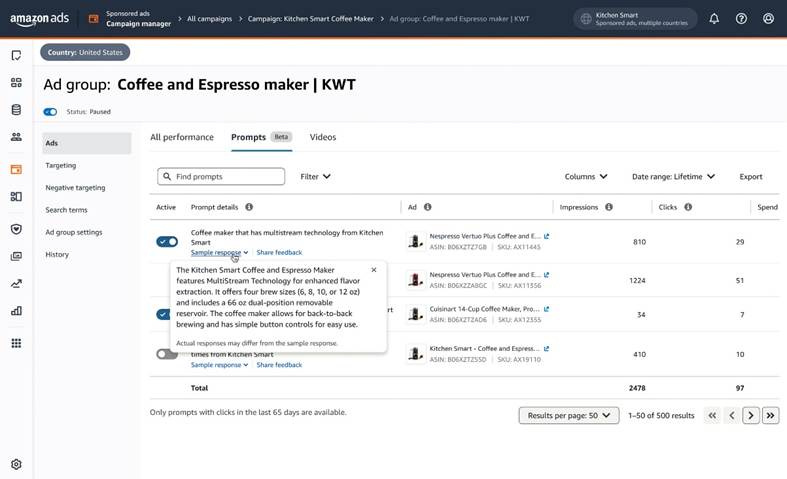
If ChatGPT opens a similar advertising portal that lists base prompts and activity, GEM effectively becomes an exercise in identifying which prompts are most relevant to your brand and how material each one is. In practice, this looks a lot like GEO, except you are paying for placement.
Getting ahead in GEM will require a deep understanding of how to rank and maintain your brand’s perception within AI search results, as well as how to adapt content strategy to the specific model you are optimizing for. If I were working at an advertising agency today, I would want to get very smart about how GEO works, as its mechanics will likely translate directly to GEM.
As the AI chatbot advertising landscape matures, I expect a similar ecosystem to form, made up of agencies that manage AI ad budgets on behalf of brands. Since some GEO platforms already pay for private data access from foundational model companies, they will have both the partnerships and insights needed to offer GEM services. Their existing strengths in sentiment tracking, prompt sourcing, and model-specific optimization will put them well ahead of non-GEO players.
Hot Take #3
By the end of the first half of 2026, advertising within Amazon’s shopping assistant, Rufus, will be a smashing success and validate AI shopping assistants as a highly effective acquisition channel.
So far, Amazon has chosen not to rely heavily on external foundational model partnerships in the same way others have, and it has been explicit about blocking third-party AI chatbots from accessing its website. Heck, they even sued Perplexity for finding a backdoor agentic shopping method through their AI-native browser, Comet. Amazon holds a clear competitive advantage through ownership of the customer relationship and deep vertical integration, spanning acquisition through fulfillment.
Note: Amazon does have a substantial investment in Anthropic and leverages Claude to help power its internally developed LLM, Amazon Bedrock.
Pure speculation here, but Amazon likely believes it does not need additional partnerships. Instead, it has been building a walled-off agentic commerce environment through Rufus, which appears to be gaining traction based on what the company shared in its Q3 earnings. As Amazon rolls out the ability to tactically target Rufus prompts within Ads Campaign Manager, brands will begin to see just how much traffic flows through Rufus and will adjust their bidding behavior accordingly.
Once Amazon becomes more transparent with AI advertising data, which I expect to happen in the first half of the year given its willingness to preview the prompts section in Ads Manager, brands will catch on quickly. A material portion of ad budgets will shift toward Rufus. While cost-per-click (CPC) will likely increase, return on ad spend (ROAS) should rise as well, driven by higher intent, clearer prompt-level insights, and improved conversion rates as Amazon continues to funnel customer attention toward Rufus. They have the data and a high-intent shopper. If someone can figure out AI advertising, it’s Amazon.