For those who work in technology, I recommend reading Something Big Is Happening by serial entrepreneur Matt Shumer. For readers outside of tech, I especially recommend it, as it may resonate most with you.
Shumer’s post on the future of life and work in the age of AI has reached over 80 million views, and he has since appeared on CNN and CBS News.
He makes some bold, dystopian predictions about how quickly AI is developing and the ramifications of its potential to fundamentally disrupt the job market, regardless of industry. Essentially, humans won’t be needed because AI can do the work for them.
I suspect many people will read this and feel confused. Where I believe Shumer missed is not diving deeper into why AI has become so capable. And that’s what I’d like to unpack today: the concept of agentic AI.
Different Types of AI
If you’re thinking, “I use ChatGPT and it sometimes gives me the wrong answer. How will this displace my job?”, I get it. I frequently receive fishy answers from AI chatbots like ChatGPT, Gemini, or Claude, and must regularly question their logic too.
But chatbots are simply the tip of the AI iceberg. The AI that Shumer is referring to isn’t the free version of ChatGPT (in fact, he specifically urges readers to try out a paid AI subscription). Like most services, the premium version is behind a paywall. The same goes for AI.
Side note: Premium AI tools are not expensive today. For a little more than the cost of a fast-casual lunch in Manhattan, about $20, you can see for yourself why experts feel uncertain about what the future will bring. Whether it’s ChatGPT Plus, Claude Pro, or Google AI Plus, pay $20 per month and see what you’re missing.
What’s the difference between “AI” and agentic AI?
Here’s how I’d explain it. What I’ll refer to as “regular AI” is interacting with an AI chatbot like ChatGPT or Gemini. You ask it questions, request tasks, and go back and forth in conversation. This is what most people’s experience with AI has been to date.
Yet over time, you notice the AI chatbot starts to forget key details from earlier in the conversation. That’s the limitation of a context window in effect. There’s a preset limit on what the AI chatbot can remember. So, you open a new session and remind it about what you had previously told it. AI chatbots are, in a lot of ways, like glorified search engines that can complete singular tasks. As you could have guessed, higher-tier subscriptions generally provide larger context windows and better persistent memory features.
Now, agentic AI executes multi-stage workflows. You can provide agentic AI goals and translate those goals into actions for the AI to take, which it can then run autonomously.
Regular AI is reactive. Agentic AI is proactive. Regular AI handles one task at a time. Agentic AI can handle many tasks, including those that depend upon another’s output.
Here’s what I mean.
AI chatbot: Summarize this article for me.
Agentic AI: You are an expert at evaluating newsletter platforms. Research the top three competitors to Substack, analyze each competitor’s pricing model, draft a pro and con list on each competitor, and then provide a recommendation with 80% confidence in a five-slide presentation deck on which competitor is the best fit for Relentlessly Curious.
In say an hour (if not sooner), you’ll have an output that would normally take a junior team member a week to complete.
I believe agentic AI is the future of work. We already have the capability to create AI “employees” by creating an agent to handle specific tasks. We (humans) will serve in the role of agent orchestrators, managing many agents and helping instruct the bigger picture of the project goal.
Agent Orchestration
Check out the agent orchestration for the newsletter platform research project mentioned above.
Research Agent: Educated on first-principles thinking and decision-making frameworks, this agent searches the web and any separately provided data source to distill a curated viewpoint on the topic you’ve requested.
Price Scraper Agent: Specifically instructed to find the current prices of pre-set competitors at a pre-defined time cadence.
Slide Deck Agent: Provided a presentation structure, brand style, and writer’s voice, this agent can build presentations for you based on the data you provide it.
As the user of AI, you can instruct the Research agent and Price Scraper agent to work in parallel and then once both agents’ work is finished, request the output be used by the Slide Deck agent to create the presentation.
You don’t need to know how to code to create the above agents. By instructing AI in natural language prompting, you are simply writing instructions similarly to how you’d teach a junior employee. And thanks to emerging standards like Model Context Protocol (MCP) which aim to connect models to external tools and data sources, agentic AI can access information across the data sources that you feed it, including your Google Shared Drive, Slack, and even Shopify account. If your organization has a written document or chart on best practices for data analysis, you can tell your AI agent to reference this document, and it will factor that into its process.
This scenario is why there’s growing anxiety in the job market. You don’t need to be an engineer to build an AI agent, which democratizes software development and puts the power in the hands of those willing to be curious.
I’m oversimplifying it, but the key point with agentic AI is that it unlocks multi-dimensional workflows typically executed upon by humans. For those of you that are looking to get ahead of the curve and understand what current AI tools allow you to do, I recommend checking out some of the following tools.
Custom GPTs in ChatGPT Plus
Custom GPTs in ChatGPT Plus are not considered agentic AI, but they are still a strong starting point. A much more robust version of an AI chatbot, Custom GPTs allow users to store information in the way of written context, files, external API integrations, and model preference. No need to re-provide baseline context each time you log in.
I encourage this as your agentic AI launch pad because it teaches you to create a knowledge base for AI to regularly pull from. Examples of Custom GPTs I’ve created include written document editors, analytical thought framework partners, and social media copy generators.
Claude Code in Claude Pro
This is my favorite agentic AI tool, and I’d liken it to magic. I’ve been increasingly relying on Claude Code in my day-to-day. It’s worth calling out that I am by no means an engineer. Despite its name including “Code” you don’t need to know how to code to effectively use the tool. I provide access to my computer files and third-party connections, as well as instructions on tasks I’d like to complete. Claude Code handles the rest. I’ll refine my prompting over time and frequently push Claude to question its own logic. But the magical thing is that this agentic AI tool can reason on its own, pressure test its assumptions, and correct itself when it senses an error, all with relatively little oversight.
I will admit, there is a bit of a learning curve with how you set up Claude Code given that you generally access it through your terminal. I recommend checking out the training program, Claude Code Course for Product Managers, to get started. I know it is meant for Product Managers, but it teaches Claude Code basics and prompting best practices in a first-principles framework. This is important for any knowledge worker. Oh, and it’s free!
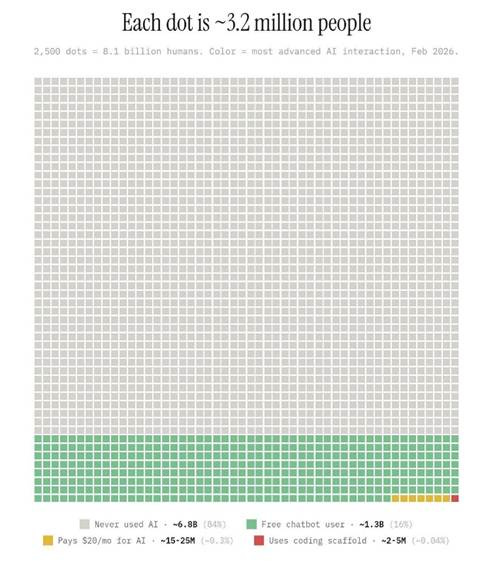
I understand this may feel overwhelming, but rest assured, you’re not behind. I’d like to share this chart from a LinkedIn post I stumbled across. Most people haven’t used AI before. And only a microscopic percentage are using AI at a high level. All you need to do is be curious and willing to explore!