

Anyone else exhausted trying to keep up to date on the latest happenings in the AI world? There are new companies, models, and use cases being spun up every day, and it’s tough to keep track of them all. It’s even tougher to tell which announcements matter and which are just click bait. It’s the classic signal versus noise problem.
I’ve found The Rundown AI helpful for staying up to date on what actually matters. It’s a daily newsletter that tells you what you need to know about AI developments for that day. They do a fantastic job separating the signals from the noise in the AI realm. You can check it out here (it’s free to join).
Why do I mention The Rundown AI? Well, because I stumbled upon a super interesting report in one of last week’s newsletters, called AI Global. For those of you unfamiliar with SimilarWeb, it’s a tech company that provides statistics on website traffic. Apologies to anyone who works there, as I’m oversimplifying. You want to know how popular your website is compared to your competitors? SimilarWeb will give you every data point you can imagine around just how many people are going to your adversary’s website each month.
So yeah, SimilarWeb put out a report on traffic trends and user engagement as it relates to AI websites and applications. A great resource on understanding not only where the puck has been, but also where it’s going when it comes to AI use case popularity. Today, we’ll be diving into AI happenings that are “legit”, and in Friday’s edition, we’ll be laying out those that are all “hype”. Let’s dive in.
Note: all screenshots are from SimilarWeb’s AI Global report.
What is “Legit” in the AI World
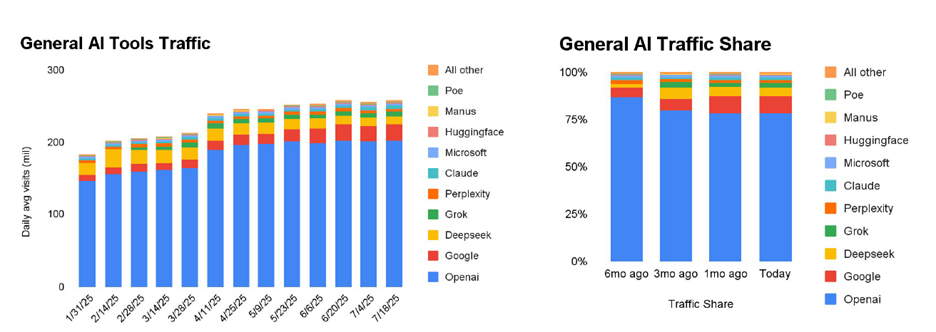
Legit Take #1: OpenAI was the first to market in producing a chatbot that can provide human-like responses, but other LLMs are quickly gaining share.
Although no longer growing at a blistering pace, OpenAI accounts for the lion’s share of traffic on these LLM creators’ front-end chat interfaces (~75% of AI traffic as of 7/18). Which is no surprise, as ChatGPT was the first LLM chat interfaces product at scale and is already on its way to turning its brand name into a noun (“I’ll ask Chat”).
However, other LLMs are growing quickly and the one I would pay closest attention to is Gemini by Google. Google has the most to lose of any Big Tech player in the changing landscape of how people search and discover information. At the same time, they still have a massive audience to introduce to their in-house LLM, Gemini. Not far-fetched to believe that Google’s growing, material share of the market is in part driven by how many people visit their browser (Chrome) or search engine and then stumble upon Gemini.
Related, Google has rapidly changed its own search experience to cater to altering macro behavior, providing a singular answer to your query as the top search result (in the way of an “AI Overview”). I expect Google’s AI traffic share to increase as their AI Overview section gives users a taste of Gemini.
In 6-12 months, I wouldn’t be surprised if the Google search results page looks even more like a blend between traditional search and LLM output-style single answer. But Google’s core business is digital advertising, and I can only speculate on how blurring the lines further between the AI Overview section and traditional search results affects what has long been their money spigot. Or maybe Google sets the standard for how to incorporate advertising into LLM output. Anyway, that’s a tangent.
Perplexity, Claude, and Grok sure do get plenty of media attention, but they’re mostly a rounding error when it comes to overall traffic share.
Legit Take #2: AI will drastically disrupt industries that either offer a commoditized service or aren’t known for being technologically savvy.
Check out the chart below that illustrates AI traffic growth for the AI travel and itinerary segment.
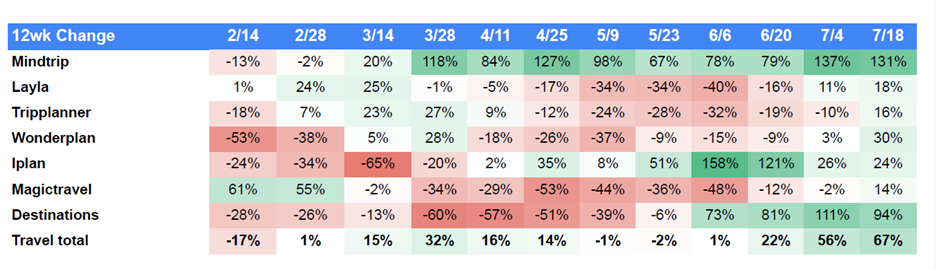
Anecdotally, travel planning is a tedious process and asking technology to scavenge the internet for me is a huge upgrade over having to create an itinerary myself. Now, there are companies that build and book itineraries for you, analyzing your social feeds to get a sense of what kind of trip you might like.
It’s a given that your classic travel agencies are toast as they charge way too much and are inefficient compared to AI solutions. But I do wonder how the big dogs in the travel industry will fare. If I’m running Expedia, Kayak, or Booking.com, my number one priority is figuring out how to show up as often as possible in LLM outputs. These companies have invested in their respective brands for decades and have become household names. However, their service offerings are commoditized and if more people rely on AI travel planners, their brand name won’t drive the same website traffic it used to.
Who stays immune to AI’s disruption of the travel industry? High-end hospitality services that cater to ultra-high net worth individuals (think Four Hundred). These companies sell exclusivity and access as it relates to travel, which is not something that can be delivered by an algorithm.
Legit Take #3: Workflow automation will continually be a focus point for businesses of all sizes.
If there’s a theme for AI in 2025, it’s workflow automation. Hundreds of companies aim to help you automate various tasks from customer service to content generation. And they can, but the real MVPs are the picks and shovels companies that make task automation actually happen. You know, companies like Zapier, Make, and n8n.
Shout out to n8n for having a great product (I’ve played around with it and find it more intuitive than Zapier). Also, shout out to whoever leads marketing at n8n, since almost every AI tutorial on YouTube mentions n8n. The plethora of n8n AI videos can’t be all a coincidence; n8n must have an influencer marketing program that is humming.
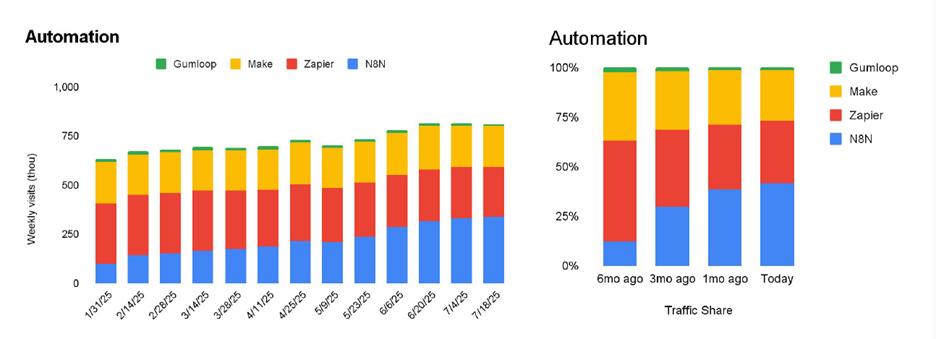
If I’m leading marketing efforts at Zapier, I’m paying for as many YouTube creators as possible in the AI space to create a workflow with Zapier’s connections. So many people (including myself) learn new skills on YouTube, making it a captive audience for companies like workflow automation tools. Zapier is the incumbent in the no code automation space, and they’re losing steam, as shown by their traffic retraction.
Perhaps I’m in an AI bubble. However, I believe software like n8n and Zapier will continue to rise in popularity (also depicted in the rising weekly traffic numbers below). It will become increasingly the norm to automate both personal and professional tasks. Unless you have access to robust enterprise software, you’ll rely on building workflows to connect programs and automate processes with the help of these little-to-no-code platforms.
That’s it for today. Join us Friday as we dig into what’s pure hype in the AI world.