

Author’s Note: On November 1, I’ll be running the 2026 New York City Marathon in memory of my uncle Chris and in support of the Parkinson’s Foundation. As this newsletter lands in your inbox, I’m likely out on a hot, humid training run. If you’d like to learn more about Parkinson’s disease or support my fundraising efforts, you can visit my fundraising page here.
I don’t spend much time on social media. In fact, I deleted the Instagram app on my phone at the beginning of the year. My weekly screen time number was higher than I’d like, and I haven’t looked back since.
However, I do still have the Facebook app on my phone and occasionally go for a good old-fashioned social media doom scroll.
And boy, things have gotten weird on Facebook.
I am now receiving ads to “sell my company’s data for AI training”.
Not ads for AG1 or the latest trendy protein powder. Ads meant for business owners to sell their company data for up to $2 million. It’s as if Facebook knows I write a Substack about AI (they know everything, so they probably do).


Let’s unpack why these data brokers have spun up, who really wants to buy your company’s data, and implications for employees and customers.
The race for niche data sets is on. As the push toward physical AI accelerates, including self-driving cars and humanoid robots, AI will need highly specific training data to produce the outputs necessary for robots to perform their intended tasks. For more on the physical AI narrative, give this article a read.
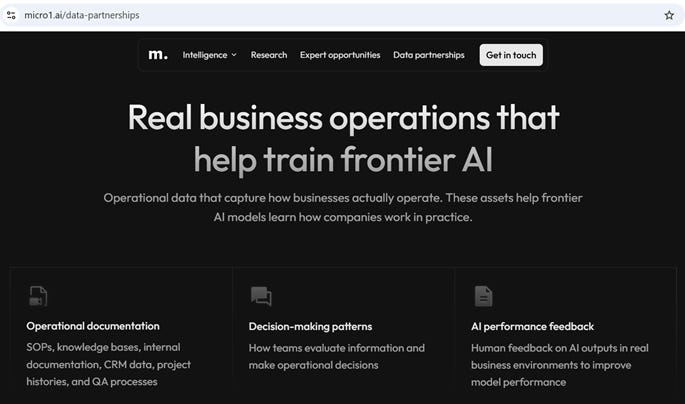
After being targeted by AI training-data companies on Facebook, I did some research into who these advertisers are. Companies like Data Factor and Micro1 are focused on acquiring training data to support model development. Data Factor’s website even states quite literally, “training data for the machines that move through our world.” As predicted back in the linked Relentlessly Curious article, a business opportunity exists for those who can acquire and consolidate niche data on real-world tasks like cleaning an apartment or delivering food. These data brokers have now expanded to acquiring data from companies in the form of “operational data and business workflows” according to Micro1. My inference is they will then package this data up and sell it to major AI labs or robotics firms. If there’s any validation that this business model has product-market fit, Google’s pending purchase of Spirit operational data shows a proof point that AI labs are willing to go to all corners of the Earth to pick up useful inputs to make their models more effective.
A key element of why AI labs care about your company’s data is for the purpose of evaluation frameworks (commonly referred to as “evals”). This is a major reason AI labs work with a company like Data Factor. See, AI still gets things wrong, and a common reason why is because it doesn’t have the right context. That’s where evals come in, which are essentially frameworks that tell the model “what good looks like” for the sake of pattern recognition. They are systematic tests used to measure whether a model or agent performs a task as per the defined requirements.
For example, if Anthropic wants to break into finance, they likely will need a lot of data on how to build a financial model, as well as how to check their work to ensure that the model was built correctly. Today, AI can build the financial model rather quickly, but can it pressure-test itself under countless sensitivity scenarios that a finance professional just “knows” from years of experience? That’s debatable, and where evals are helpful.
If Anthropic buys a financial advisory firm’s financial model files and related analysis documents, they can then instruct the AI on all the edge cases that may come up and the AI will be able to check its work more effectively. A company with decades of operations has encountered every outlier scenario under the sun, allowing it to help inform what the most “correct” output can be.
So, let’s break this down further. When an AI lab acquires a niche data set like a company’s workflows, they get tons of raw training data to improve their model, evaluation data to test said model, and documentation produced by humans that shows judgment and nuance on how outputs are assessed. Evals help bridge the gap between training data and a finished product.
Although I question why Data Factor and Micro1 are advertising on Facebook, they are likely trying to reach small business owners, as there are too many complications involved in asking a corporation to sell its data (I can’t imagine shareholders would be pleased with a company selling what could be their secret sauce). There are over 36 million small businesses in the US, and I’m sure most of them would appreciate another $1 million in exchange for their data.
The advantage most companies have over the AI labs is that they understand their customers’ data and workflows inside and out. Thus, it’s a bit ominous to think that if small businesses hand off their niche understanding of how to work with certain types of customers (let’s assume actual customer data is not for sale, only the workflows behind them), eventually the LLMs will close the gap. What could lead to a banner year in profitability for a small business in 2026 may lead to a structural decline in revenue in 2028 as the LLMs build strong evaluation frameworks around the problem the small business was solving a few years back.
Furthermore, the idea of selling a company’s data is not a new concept. In the consumer world, it’s a somewhat common practice to buy a defunct brand’s email list for the sake of extending a brand’s broader customer list. When you as a customer sign up to receive marketing emails, you may have little idea where your data is going (unless you read the Terms of Service, which I bet is highly unlikely).
Now, as an employee, all those standard operating procedures (commonly referred to as “SOPs”) you wrote over the years may be packaged up and sold to OpenAI or Google to fine-tune AI trying to do your job. It feels kind of funny, and in not the “ha-ha” way.
But that’s the way the world is going. I’m very curious to see how many businesses take up offers from Data Factor, Micro1, and other AI data brokers. Which companies will shun the idea of selling their workflows while others may not see much value in them and thus view it as extra pocket change to keep the lights on.
The extent to which AI labs are going to acquire the most random data sets really proves out the saying, “one man’s trash is another man’s treasure.” Who knew how valuable trash was, huh?