

Author's Note: This is the first of a three-part series exploring the future of agentic commerce and why OpenAI's shopping ambitions face an uphill battle.
If you want to learn about a company’s future strategy, look at the roles they’re hiring for.
See below for open product management roles at OpenAI.
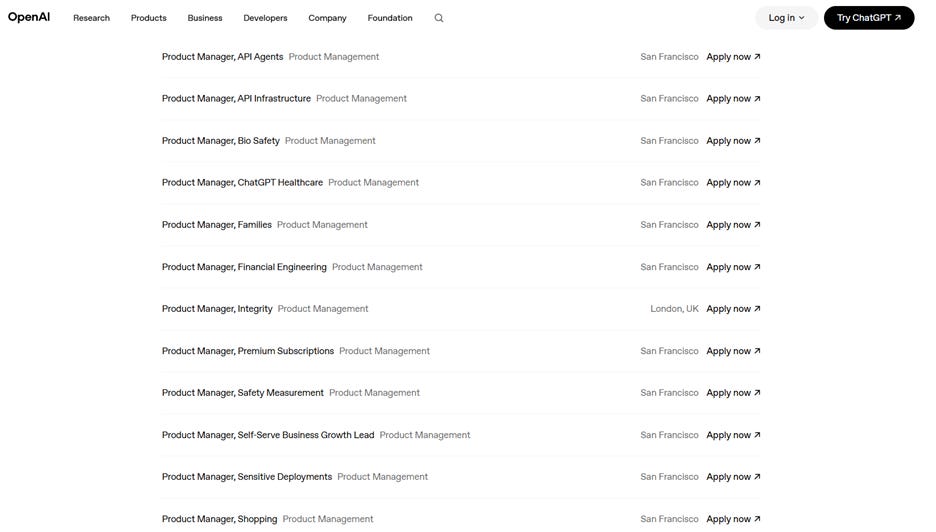
I’d like to zone in on the last product manager open role in the screenshot above. The shopping role caught my attention. You see, if a company’s open roles list is any indicator of their plans, then it looks like OpenAI is going to take another crack at being able to check out within ChatGPT.
We’ve talked a lot about agentic commerce in Relentlessly Curious, including OpenAI’s struggles getting Instant Checkout off the ground. So here’s the short version: OpenAI launched their shopping product last October. It was a slow roll-out to several big consumer brands (like Skims) and retailers (like Walmart). Consumer interest was limited and Walmart was vocal that they saw a materially lower conversion rate within ChatGPT than on their website. Simply put, it failed to gain meaningful traction.
Why did it fail? Operationally, agentic commerce requires an enormous amount of infrastructure. And from a conceptual lens, AI is best suited for purchases that you have a general sense of what you want to buy from the get-go. It’s not effective for discovery.
Need a refresher on agentic commerce? Check out AI + Shopping, When AI Buys Your Groceries, or The Case Against Instant Checkout.
In AI + Shopping, we chatted about how AI will bifurcate shopping into two forms: monotonous commerce and discovery commerce. The former focuses on routine purchases like paper towels and toilet paper. Grocery shopping can fall into this category too. Monotonous commerce is a natural fit for agentic commerce, as these types of purchases are low-stakes, frequent, and commoditized.
On the other hand, discovery commerce focuses on higher-ticket, emotional purchases. Think of jewelry, a car, or even a house. You may use AI to help you research which necklace, SUV, or property you would like to buy, but most people probably wouldn’t let AI make the purchase on your behalf. Likewise, the seller may not feel comfortable selling you such a high-priced item either via an agent either.
There are so many considerations when it comes to agentic commerce. Like which forms of payment are accepted and who maintains their security, who handles fulfillment and returns, and who accepts responsibility if an agent makes the wrong purchase. It’s an incredibly tall order to take on and requires coordination across many counterparties (see Universal Commerce Protocol).
If I was advising OpenAI on integrating shopping back into ChatGPT, I’d tell them to focus entirely on routine commerce. Make the user experience as seamless as possible to order groceries, soap, and napkins. Whether that experience is when a user wants to check out for themselves within ChatGPT or set a few guardrails and let an agent buy these products for the user on a recurring basis, the user must go from discovery to transaction quickly and smoothly. The goal is to gain consumer trust and associate ChatGPT with shopping on the “no-brainer” items, so that OpenAI can gain methodocially gain trust on the more ambiguous shopping requests. And associate their brand with all types of shopping.
But here’s the thing. There’s another company that has already mastered low-stakes, routine commerce in the eyes of the consumer. It’s Amazon. They’re arguably the furthest ahead when it comes to agentic commerce too.
I believe Amazon is all over the monotonous commerce element and most likely to succeed in the long run because of how operationally sound they are. They have decades of commerce data, what appears to be the most functional AI shopping chatbot (Alexa for Shopping), and a fulfillment service that no other company can reasonably compete with.
But I want to address the elephant in the room. These types of purchases are routine-oriented, which is best fit for a subscription. Is there really that much value in an AI agent knowing the stock in your refrigerator and auto-ordering when your egg carton has only a few eggs left, when your weekly Instacart order is going to restock you soon anyway? Subscriptions already solve predictability without introducing another layer of decision-making. Is OpenAI trying to pair its incredible technology with a pain point that really doesn’t exist? Don’t subscriptions (either on Amazon or on a DTC website) already solve this problem?
My point is, AI agents today are best suited to shop on behalf of people on low-stakes, routine purchases. If these purchases are so predictable, wouldn’t it make more sense to order a product on a subscription than leave it up to an agent to execute? Then you have certainty of the price and timing, versus providing guardrails and introducing a probabilistic element with AI.
So, if AI is best suited for monotonous commerce and Amazon already has major structural advantages, OpenAI will need to win in discovery commerce.
However, today’s AI struggles with the discovery phase of shopping. Rarely do I know exactly what I want. And if I don’t know what I want, I don’t know what to prompt ChatGPT with either. AI works best when you have a solid idea of what the end state should look like. What happens when you have no idea what you want to buy? How does that work with AI?
A few weeks ago, I was in the market for a few long-sleeve button-down shirts. I needed a shirt that was professional, yet laid-back in the sense that you don’t have to tuck it in.
As someone who doesn’t shop frequently, I didn’t really know what kind of shirt I wanted. It just couldn’t look too much like the shirts I already owned.
I went to an outlet mall and walked around to a few stores. I figured I’d know what I was looking for when I saw it.
And that happened. I walked into Banana Republic and quickly saw a shirt I liked. It wasn’t what I originally thought, nor was it something I would have prompted to AI. I just liked the shirt, tried it on, and I bought it. Simple as that. It looked cool and fit well.
Although a relatively low stakes purchase regarding the amount I spent, I’d classify this transaction as discovery commerce. I had only a general idea of what I wanted to buy, and seeing options in person, being able to touch them and try them on, helped seal the deal for me.
OpenAI will need to create a digital equivalent of walking through a mall or scrolling Pinterest. We will talk about how OpenAI can create the discovery side of commerce for the agentic era in next week’s issue. Stay tuned.