

Author’s Note: Relentlessly Curious will be off next week. New issues will resume on July 28th.
Writing the Revisiting AI + Shopping series was fun and thought-provoking. It’s incredible how much has changed in AI and agentic commerce over the past year, so it was worth reevaluating the landscape. What’s even more interesting is how much hasn’t changed when it comes to AI’s impact on shopping. If you’re new here (or would like to give it another read), I’ll link each part at the bottom of the article. You’ll get the rundown on agentic commerce’s fundamental flaws, data collection challenges, and the companies most likely to win the race.
Now, onto regularly scheduled programming.
We are back with our 9th edition of Hot Takes in AI. I’ve had a few queued up and I’m looking forward to diving in.
Hot Take #1: There is not a clearer signal of the physical AI narrative gaining steam than Anthropic hiring a Human Data Platform product manager.
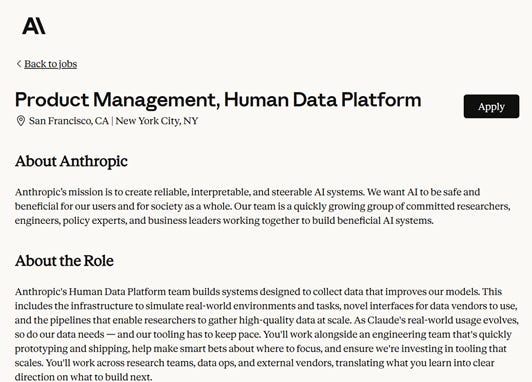
I’ve said it before, and I’ll say it again: you get a peek at a company’s long-term strategy by combing through their active job openings. And if you are looking at the Careers portal at a company like Anthropic, you get a peek at what the future of technology holds.
I’d like to highlight a few sentences from the product manager role above.
“Builds systems designed to collect data to improve our models. This includes infrastructure to simulate real-world environments and tasks”
“Good instincts and an eye for intuitive user experiences, particularly those involving complex UI interactions or annotation workflows”
We’ve been highlighting the need for AI labs to acquire offline data to improve their models, as there is a relatively finite amount of information online. This data will be crucial for the robotics industry to power the next wave of “autonomous” everything.
My interpretation of this job posting is that Anthropic wants to productize the collection of offline data and is looking for someone who can navigate messy workflows, which sounds a lot like how getting data from people recording themselves will go.
I have a hunch this role will work closely with external data providers of real-world data. Companies like DoorDash, or Uber, and even Shift. Perhaps even a marketplace like Mercor that acts like TaskRabbit but for white collar work. Companies will view their real-world data collection as a monetizable revenue stream and ultimately sell it to AI labs.
Calling back to a previous Relentlessly Curious article: can you imagine how messy the data will be when maids on Shift submit their cleaning recordings? Of course, AI will take a first pass, but someone on the AI labs side will have to find a way to structure this data in a format that can inform an LLM. A difficult task, but incredibly interesting work.
Expect more job postings like this from OpenAI, Google, and even xAI. The robotics industry needs offline data, and the frontier labs would likely want to capitalize on this opportunity because real-world data improves their models and creates another big business opportunity.
Hot Take #2: Meta’s stock has been punished over the past year because the market doesn’t believe it should deviate from being an advertising business.
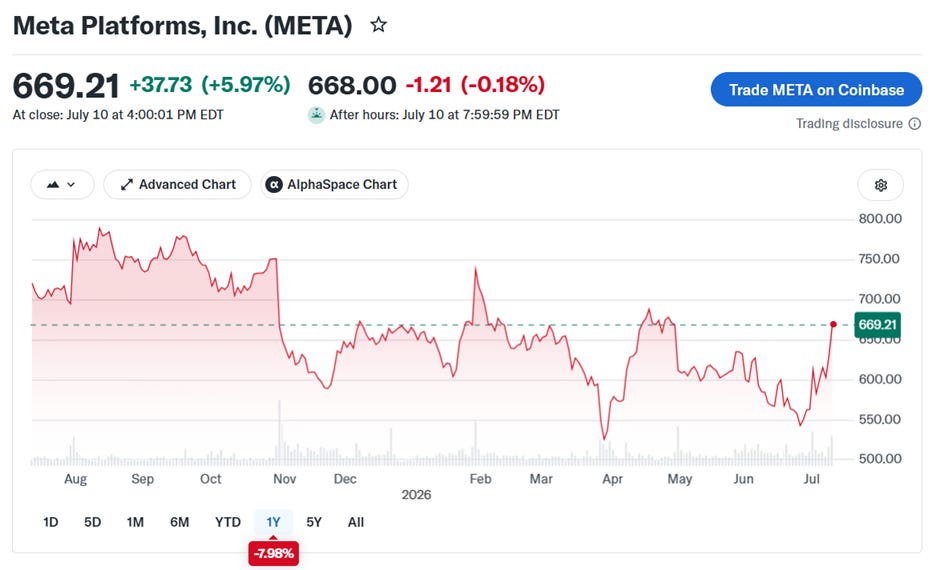
Source: Yahoo Finance
Not considering a recent uptick, Meta’s stock price has been down a double-digit percentage year-over-year. The market has not been kind to Meta, as the market is asking a very fair question: does Meta really need to spend $135B this year on AI capex in the name of making their ads more efficient?
99% of Meta’s total revenue stems from advertising. Let’s not shy away from the numbers: Meta is an ad-tech company. It sells ads.
However, Meta does have a few side bets in the works, including an internally developed frontier model (codenamed “Watermelon”), as well as the recent announcement of a cloud computing business.
It sounds like they are trying to encroach on every Big Tech player’s turf (cloud, frontier model). But Meta is late to the party. The market has already discounted its juggernaut advertising business (as reflected by the stock performance) for their side bets. And if they want any sort of shot to build their cloud book, they’ll need to steal share from Google, Amazon, and Microsoft. The only wedge I could see working is if Meta commits to underpricing their competitors. Which is a bold bet that I doubt the market will tolerate given the time it will take to build the tens of billions of dollars in cloud revenue needed to compete with the incumbents.
And who knows if Meta will try for enterprise adoption of Watermelon. Good luck gaining a sliver of the market from OpenAI, Anthropic, Google, and xAI. Not to mention the Chinese models.
I get that Meta is a Big Tech player and needs to have a massive AI story. But its advertising business is the most efficient on the planet and keeping the focus there should be the top priority.
Playing devil’s advocate, Meta’s current market capitalization is $1.7T. If Zuckerberg needs a story to get Meta to $3T, further optimizing ads is the play. But if the goal is $10T, I get it. Meta will need to make company-altering, strategic bets to achieve exponential growth from here. Given Meta’s massive AI capex budget, my take is that Zuckerberg is more focused on the $10T figure, instead of the $3T figure (all speculative). He built a multi-trillion-dollar company from scratch, so perhaps the market should give him slack to pursue a few moonshot bets.
But it’s going to be a long, bumpy road for shareholders since Meta will be playing catch-up with foes who are spending just as much if not more on AI capex.
Hot Take #3: AI labs’ new model release strategy is weird.
Call me a luddite, but I really don’t understand the emphasis on AI model benchmarks.
Last week, OpenAI announced the release of their flagship model, GPT 5.6. With major improvements for cybersecurity and agentic coding, it’s expected to pose as a formidable competitor to Anthropic’s Opus 4.8 and Fable 5.
Regardless of the model, each AI lab’s press release is a rundown of model performance versus benchmarks.
Here’s the thing: do model benchmarks make sense to be the bulk of a new model release, if the focus for AI labs is to show blistering revenue growth?
For what it’s worth, the AI labs are growing quite quickly. Specifically, Anthropic is setting records each month, with its annual recurring revenue (ARR) expected to breach $70B by month’s end. Keep the revenue machine humming, but maybe the model release should be a tactical use case demonstration. Pair what works well about your new model against your competitors’ weaknesses. Highlight an early beta partner client for the model release and the value it drove for them. Literally anything besides showing a leaderboard on various exams that mean nothing to almost every consumer and most enterprise buyers. I haven’t come across anyone in my work that claims they use one model over another because it’s atop the model leaderboard.
Call me a luddite for not being entertained by the model benchmarks. I’m not an AI researcher.
Just show me what the model can do and how it fits into my workflow. Then I’ll decide if I want to use it or not.
Revisiting AI + Shopping Series